



A illuminated two-story red brick house on a quiet residential street at dusk, flanked by mature trees under a deep blue evening sky.

Furnace Maintenance in Le Mars, IA

Tell us about the job

Takes about a minute. No obligation.

Tune-up, service, or cleaningFurnace or heatingPlymouth County, IA
Step 1 of 2

What ZIP code is the job in?

Furnaces in Plymouth County run from October through May, about eight months of the year. Overnight lows average 13°F through December, January and February, and the furnace has to hold against that night after night. A system working that many cold nights wears its parts sooner than one that only kicks on now and then. The igniter, the blower motor, the heat exchanger all put in more hours here than they would somewhere milder. That wear doesn't announce itself. It shows up as a hard start or a short cycle right when the cold sets in.

Furnaces in Le Mars start their eight-month run in October.

Have it checked in September, before that first cold month asks anything of it.

An older furnace needs a closer lookHalf the homes in Plymouth County were built in 1971 or earlier.

A furnace move air across the heat exchanger, and nothing about that changes if the filter is dirty or clean. A clogged filter just restricts how much air can get through. Airflow drops, the exchanger holds onto more heat than it should, and the furnace can overheat and shut itself down on a high limit switch. That's the furnace protecting itself, but it still leaves the house cold until someone resets it or swaps the filter. The blower motor feels it too, since it works harder pulling air through a blocked filter and that shortens its life. None of this is complicated to prevent. A filter changed on a regular schedule keeps air moving the way the system was built to move it, and that alone prevents a lot of the calls that start with 'it just stopped working.'

Have the burner and venting checked, not just the filter

Gas heats most homes in Plymouth County, and LP gas heats another share on top of that. A furnace burning gas or LP needs its burner, venting and safety controls checked. A clean filter doesn't cover any of that.

Find a contractor
A man in a cap, gray long-sleeve shirt and brown pants carries a canvas tool bag up porch steps toward a dark front door, beside a potted shrub.
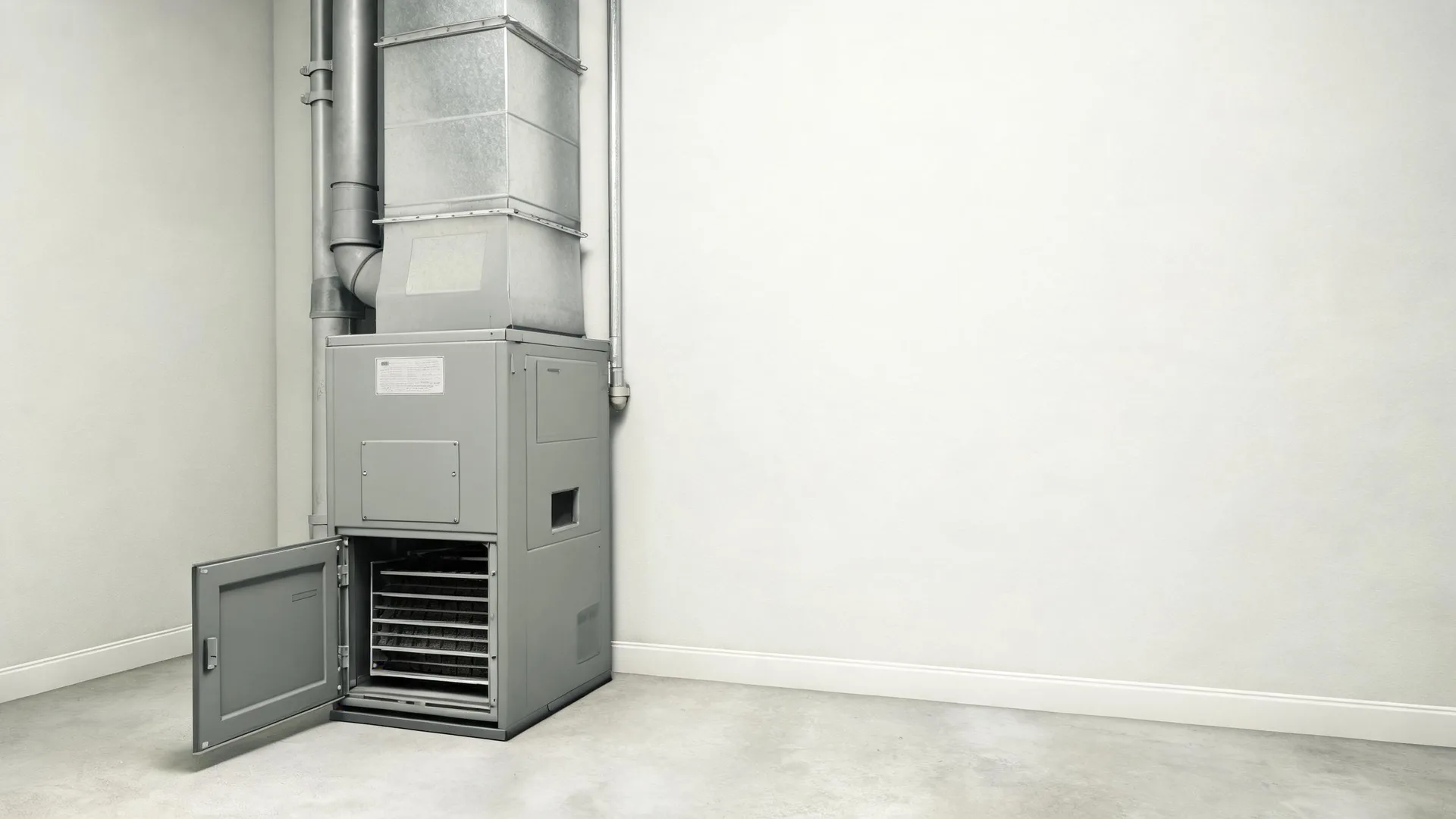
A gray residential gas furnace installed in an unfinished basement, connected to sheet-metal ductwork and PVC pipes.

Catch the wear before the cold does

Get it looked at before October, not after. A technician can catch a cracked igniter or a blower motor on its way out while the furnace is still sitting idle. Once the cold settles in for those eight months, the same part failing means a house with no heat and a wait for a repair instead of a scheduled one.

A smell that wasn't there before

A furnace that's been running fine shouldn't smell like anything beyond a little dust burning off the first time it fires up. A sharp or musty smell after that, or any smell that lingers once the furnace has been running a while, is worth having looked at. So is soot around the burner or a yellow flame where it should burn blue.
Sounds the furnace didn't used to make

A bang when it fires up, a rattle from the cabinet, a squeal when the blower starts. Furnaces run quiet when everything inside is seated right and spinning true. New noise means something shifted, loosened, or started wearing, and it's easier to deal with before it causes a bigger failure than to fix after the part gives out.

Skip maintenance long enough and the furnace doesn't fail all at once. The burner keeps burning a little dirtier each season, the flame sensor builds up a coating it didn't have before, and the blower bearing runs a little drier than it should. None of that stops the furnace from starting. It just makes the start harder each time, until one morning the igniter can't get the flame lit or the sensor can't tell there's a flame at all, and the furnace shuts itself down. A technician looking at it once a year catches the sensor before it's coated enough to matter and the bearing before it seizes. Left alone, the same parts wear on their own schedule instead, and that schedule tends to land on the coldest night it can find.

A tune-up starts with the furnace taken apart far enough to see the parts that do the work, not just a glance at the filter. The burner assembly comes out for cleaning, since a burner caked with dust or corrosion burns uneven and throws off more carbon monoxide than a clean one. The flame sensor gets wiped down, because that coating that builds up on it is exactly what causes a furnace to shut off right after it starts. The igniter gets checked for cracks, the blower wheel gets checked for dust buildup that throws it off balance, and the blower motor gets lubricated if it takes oil. A technician tests the limit switch, the gas pressure and the venting, since a furnace venting wrong can put combustion gases where they don't belong. Every connection gets checked too, because a furnace vibrates a little every time it runs and that loosens things over years nobody notices until a wire or a fitting finally fails.