A row of dark-sided single-story houses among large deciduous trees, with a trimmed hedge in the foreground and a mown lawn crossed by a paved path.

Furnace Repair in Le Mars, IA

Tell us about the job

Takes about a minute. No obligation.

RepairFurnace or heatingPlymouth County, IA
Step 1 of 2

What ZIP code is the job in?

Half these furnaces sit in older houses

Half the homes in Plymouth County were built in 1971 or earlier. A furnace doesn't last as long as the house does, so if yours came with the place, it's probably had at least one replacement already, maybe more.

Age changes what a repair call means

On a furnace from the last several years, a repair is usually just a repair. On one that's older, or that came with an older home, the same breakdown is worth asking a second question: how much life is left in it before the next one.

8 months
October through May, your furnace is on duty
13°F
the average winter night it heats against
26 winter storms
in ten years, the nights a failure hurts most
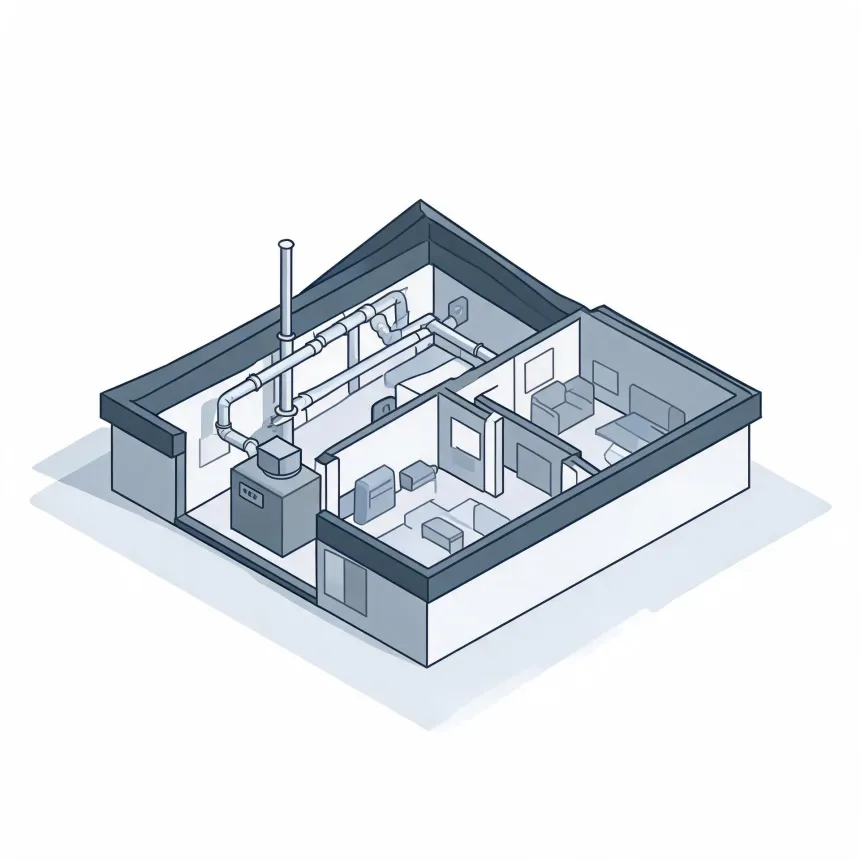
Isometric line illustration of a cutaway building interior showing a furnace unit with a flue pipe and ductwork running along the ceiling, plus adjacent rooms with simplified furniture.
Your furnace works hardest from November through March.

NOAA nClimDiv, 1991–2020 normals

A furnace that short cycles is working too hard to catch up on a call.

If it's shutting off before the house reaches temperature, the problem is worth finding now, not after it quits for good.

Eight months of heat a year wears a furnace down faster

Heat runs October through May
Winter nights average 13°F
Climate zone 5A
October is when the weak ones quitFurnaces here start working in October, and that first cold snap is when a part that barely made it through last winter finally gives out.

A tech starts by asking what the furnace is doing before touching anything. Short cycling, no heat, a burner that won't light, a smell on startup all point different directions. From there it's a look at the flame itself. A steady blue flame means the burner is getting the right mix of air and gas. A flame that's yellow or flickering usually means it isn't, and that's worth finding before it's left to run that way. The igniter gets checked for a crack or a weak glow, since a failing one will light the furnace some days and not others. The flame sensor gets cleaned or tested, because a coated sensor reads no flame even when there is one, and shuts the burner right back off. Airflow gets checked too. A return that's blocked or a blower wheel caked with dust makes the whole system work harder and can trip the limit switch that's there to keep the heat exchanger from overheating. Whatever's found, a tech should be able to point to the part and explain what it's doing wrong, not just that something is wrong.

Ask what the furnace itself tells you, not just the house

A furnace that came with an older home has likely been replaced before, but there's no way to know that from the house alone. A tech can look at the unit itself, the age on its nameplate, and tell you whether this repair is worth making or whether it's time to plan for what comes next.

Find a contractor
A man seen from behind in a dark sweatshirt and tan work pants climbs porch steps toward a gray paneled front door, carrying a canvas tool bag in his right hand, with a potted shrub to the left.
A gas furnace with attached ductwork, gas piping, and condensate lines installed in a concrete-block basement.

Eight months a year adds up fast

Eight months of heat is more runtime than most furnaces in this country ever see, and this one has been doing it every winter it's been in that house. When a tech gets the panel off, that history is usually right there in the burner and the blower, not just in the thermostat log. Ask for the actual reading, not just whether something's wrong. A cracked igniter or a dirty flame sensor is a straightforward fix. A heat exchanger with stress marks from years of long runs is a different conversation, and it's one worth having before money goes into the smaller repair.

Check the thermostat and the filter first

Make sure the thermostat is set to heat and the setpoint is actually above room temperature. A dead thermostat battery can leave the display lit but the furnace unable to get a call for heat. Then look at the filter. One that's packed with dust chokes airflow, and a furnace starved for air will run short cycles or trip off on its own before it ever reaches the thermostat's target.

Look at the switches before you call

Check that the furnace switch, the one that looks like a light switch near the unit, is flipped on. Check the breaker too. If the furnace has a standing pilot, see whether it's lit, and if it has a glass viewing port, look for a steady flame rather than one that's weak or keeps going out. None of this fixes a bad igniter or a cracked heat exchanger, but it rules out the simple stuff before anyone opens the cabinet.

An unfinished concrete basement containing a metal HVAC air handler, exposed wooden ceiling joists with sheet-metal ducts, a hanging bare bulb, copper pipes, and stacked cardboard boxes.

A new furnace would cut about $110 a year off heating for a typical Plymouth County home.

  • A new high-efficiency furnace$470 a year
  • An older furnace$580 a year

Estimates for a typical Plymouth County home, compared with an older unit built to the previous federal minimum, from EIA household energy data, Iowa fuel prices and NOAA climate normals. Your home will differ.

Repair makes sense when one part has failed and the heat exchanger is sound.

Replacement makes sense when the heat exchanger is cracked or the furnace keeps needing parts.

A repair decision really comes down to what broke and what it sits next to. A cracked igniter, a bad flame sensor, a failed inducer motor, these are parts that fail on their own, and swapping one out brings the furnace back to normal. The heat exchanger is different. It's the one part that isn't meant to be replaced on its own, since the cost of doing that work usually isn't far off from a new furnace. So the part matters less than what else is showing wear at the same time. A furnace that's needed a few service calls in close succession is telling you something even when each individual fix is small and cheap. Worn parts don't fail in isolation forever. Once the heat exchanger or the main control board is the thing that's failed, that's usually the point where fixing it and replacing the furnace cost about the same, and it's worth asking which one actually makes sense before agreeing to the repair.