Gas heats most homes here
Utility gas heats 45.7% of occupied homes in Plymouth County, electricity another 37.5%, with the rest mostly on bottled or LP gas. A furnace in the basement or a closet is what most houses around Le Mars already have.
Takes about a minute. No obligation.
Utility gas heats 45.7% of occupied homes in Plymouth County, electricity another 37.5%, with the rest mostly on bottled or LP gas. A furnace in the basement or a closet is what most houses around Le Mars already have.
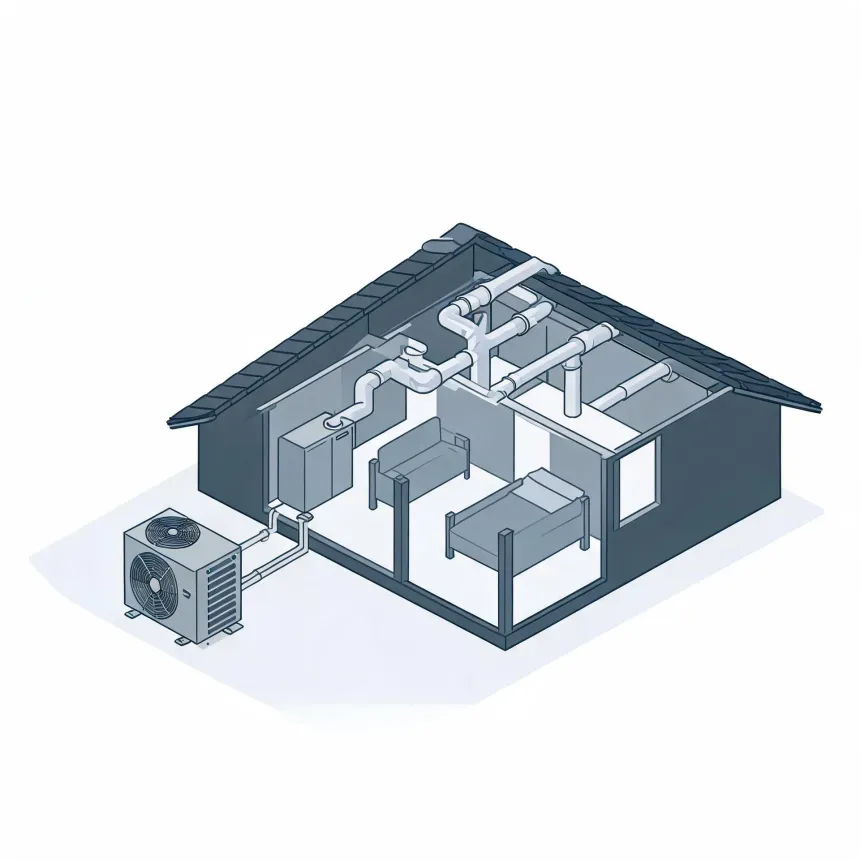
Adding a heat pump here usually means setting it alongside the furnace rather than ripping anything out. The heat pump handles the mild months, and the furnace stays ready for the cold stretch of winter.
NOAA nClimDiv, 1991–2020 normals
Plymouth County sits in zone 5A, a cool climate where the heating load is bigger than the cooling load.
A heat pump sized for this county doesn't need to be oversized or special, it needs to handle a real winter and hand off to the furnace when it gets too cold to keep up.




Electricity in Plymouth County runs about 10.78 cents per kilowatt-hour, lower than most of the country pays. That changes the math on a heat pump a little. The highest-efficiency model on the lot will still cost less to run here than it would somewhere with pricier power, but it also takes longer to earn back the difference in price over a mid-efficiency unit. That doesn't make efficiency pointless, it just means it shouldn't be the only thing driving the choice. What matters more is whether the unit is sized right for a Plymouth County winter and built to hold up alongside the furnace it's paired with.
Heat runs here from October through May. If the install happens in September, it's done before any of that starts, on a schedule you control instead of one set by a cold snap.
Find a contractor
A heat pump installed now will run through decades of this house's life, day and night, summer and winter. If the house was built in 1971 or earlier, that's the installer's cue to look at what's already there rather than assume. The ductwork and venting were sized for whatever furnace came before, and a load calculation needs to look at this house, not just its square footage. Older ducts can usually still move the air a heat pump needs. Someone has to check that, not guess at it.
Installing a heat pump next to a furnace doesn't retire the furnace. It gets wired into the system as backup, taking over when the outdoor temperature drops too low for the heat pump to keep up efficiently. The furnace isn't being removed or replaced, just handed a smaller job than it had before.
If there's an old air conditioner being swapped out for the heat pump's outdoor unit, that unit gets disconnected, the refrigerant recovered, and the unit hauled off. Any old thermostat or control wiring tied to a cooling-only setup gets replaced with one that can run both heating and cooling modes, since a heat pump needs a thermostat built for that switch.
The label on a heat pump carries two numbers, one for cooling and one for heating. Both describe the same thing: how much heat gets moved per unit of power the system draws. A higher number means the compressor and coil are doing more work for less electricity, not that the unit heats or cools faster. Two systems can feel identical in the house and still pull very different amounts of power to get there. The rating also assumes the unit is matched correctly with its indoor coil and installed the way it was designed to run. A high-efficiency outdoor unit paired with the wrong coil, or set up with a refrigerant charge that's off, will run well below what its label promises. The number means something real, but only once the installation holds up its end.
Plymouth County falls under zone 5A in the 2021 energy code, a cool climate where the furnace does more work over a year than the air conditioner does. Any split-system heat pump sold new here, if built after January 1, 2023, has to clear federal minimums to be sold at all: at least 14.3 Btu of heat moved per watt-hour of power in summer, at least 7.5 in winter. That's not a target a contractor aims for, it's the floor every unit on the lot already meets. What changes from one model to the next is how far above that floor it sits, and what that costs up front versus what it saves running. The county's climate doesn't push the minimum higher than other zones, it just means the heating number matters more here than the cooling one does.