


A illuminated two-story red brick house on a quiet residential street at dusk, flanked by mature trees under a deep blue evening sky.

Furnace Installation in Decorah, IA

Tell us about the job

Takes about a minute. No obligation.

New system or replacementFurnace or heatingWinneshiek County, IA
Step 1 of 2

What ZIP code is the job in?

Nine months a year, a furnace in Winneshiek County is working. September through May, it cycles on and off to keep up with whatever the day brings, and here that includes real cold, not just a few hard weeks. That kind of run time adds up faster than it does in places where the furnace rests half the year. The igniter, the blower motor, the heat exchanger, all of it sees more hours and more stress each season. A unit sized wrong or installed to cut corners will show its weak points sooner here than somewhere milder. Picking the right furnace for this place matters more than picking the cheapest one.

9 months
September through May, your furnace is on duty
11°F
the average winter night it heats against
80% AFUE
the federal minimum any new unit must meet
Isometric line illustration of a cutaway single-story house showing interior rooms with furniture, ceiling ductwork, a chimney flue, and a furnace unit outside the exterior wall.
Your furnace works hardest from November through March.

NOAA nClimDiv, 1991–2020 normals

Half the homes in Winneshiek County were built in 1962 or earlier.

A furnace going into a house that old has to match the house, not just the floor plan.

Gas heats most homes here, so a gas furnace is the straightforward replacement

42.1% of homes heat with gas
Heat runs September through May
Winter nights average 11°F
Get it done before SeptemberHeat goes on in September here and stays on through May.

Winneshiek County falls under zone 5A, a cool, humid climate where heating carries most of the load. Any new furnace going in here has to meet the federal minimum for that kind of equipment. Furnaces built from November 2015 on have to turn at least 80 percent of the gas they burn into heat over the winter. That floor holds until December 2028, when it rises to 95 percent for units made after that date. A furnace that clears today's minimum won't need to clear tomorrow's, since the higher standard only applies to equipment built once that date arrives.

Size the new furnace to the house you have

If your house is one of the older ones here, have the installer size the new furnace to the house, not to the one it's replacing. A load calculation tells them what the house actually needs before they quote a unit.

Find a contractor
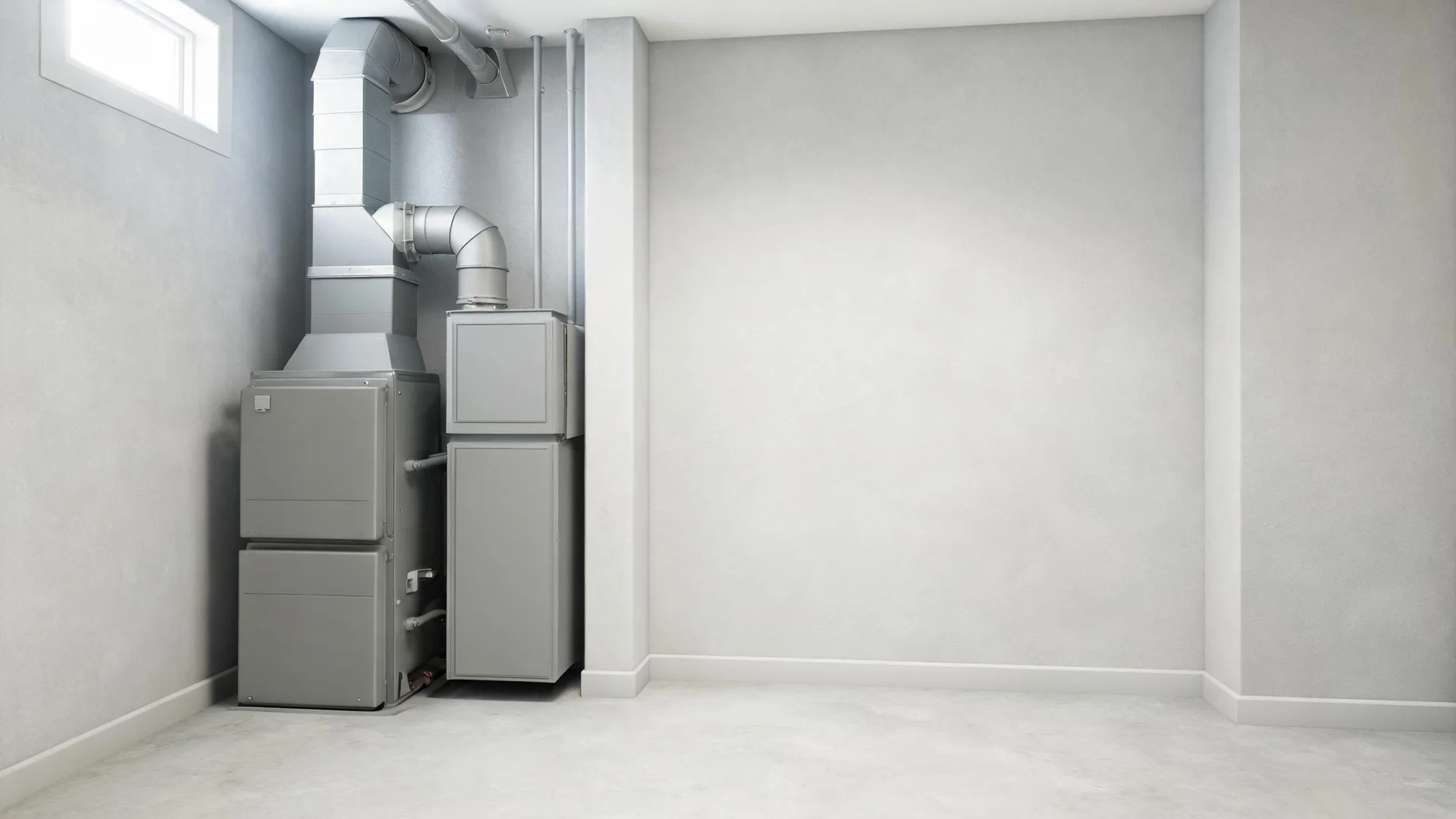
A gray residential gas furnace installed in an unfinished basement, surrounded by ductwork, a metal flue pipe, and a gas supply line.

Working nine months of the year, start to finish

Nine months of run time a year uses up a furnace's working life faster than it does anywhere the season is shorter. That's the case for getting the sizing and installation right the first time, since this one won't get an easy stretch to make up for it. Ask the installer for the load calculation in writing before you agree to a unit. A furnace that fits the house will cycle less and hold up longer than one bought because the number on the sticker looked good.

The rating tells you where the waste goes

The AFUE number on the label says how much of the gas burned turns into heat in the house and how much goes out the flue. A furnace that misses the mark wastes fuel every time it fires, not just on the coldest nights. That number holds for the life of the unit. It doesn't drift with age the way a filter gets dirty or a belt wears thin, so what you install is what you're stuck with.

Higher efficiency changes what the installer has to run

A furnace rated higher in efficiency pulls more heat out of the exhaust before it leaves the house, which means that exhaust comes out cool instead of hot. Cool exhaust can't vent up a traditional metal flue, so it needs its own venting, usually a plastic pipe run to an outside wall. That's a different installation than swapping in a like-for-like furnace, and it's worth asking about before the quote comes in, not after the pipe is already run.

An unfinished basement featuring concrete block walls, exposed floor joists, and a metal forced-air furnace with ductwork near a central pillar.

A high-efficiency gas furnace would save about $110 a year to run in Winneshiek County compared with a gas furnace.

  • A high-efficiency gas furnace$500 a year
  • A gas furnace$610 a year

Estimates for a typical Winneshiek County home, from EIA household energy data, Iowa fuel prices and NOAA climate normals. Your home will differ.

Installation starts with the old furnace coming out, not the new one going in. The installer disconnects the gas line, the electrical, and the venting, then takes the whole cabinet out through whatever door it fits through. Once it's out, they can see the ductwork and venting clearly for the first time, which sometimes changes the plan for the day. Setting the new furnace is quick compared to everything around it: leveling the unit, connecting the supply and return plenums, running new venting if the furnace calls for it, wiring the thermostat and control board. Gas and electrical get hooked up last, then the installer fires it and watches it run through a full cycle. Before they leave, they should check the flue draft, test the gas pressure, and walk the house with you to show the thermostat settings and the filter location.