A row of dark-clad gabled houses with gray shingle roofs behind trimmed green hedges, mown lawn, and leafy trees under an overcast sky.

Furnace Repair in Indianola, IA

Tell us about the job

Takes about a minute. No obligation.

RepairFurnace or heatingWarren County, IA
Step 1 of 2

What ZIP code is the job in?

Eight months of work a year

Furnaces in Warren County run from October through May. That is most of the year asking the igniter, the blower motor and the heat exchanger to cycle on and off, day after day. A furnace that only had to carry a few mild months would wear at a different pace.

What that means for your repair

A furnace running this many months a year shows its weak points sooner. The part that is struggling now has likely been struggling for a while. Getting it diagnosed properly, rather than guessed at, is what makes the fix hold.

8 months
October through May, your furnace is on duty
17°F
the average winter night it heats against
54%
of homes here heat with gas, so most furnaces here burn gas
21 winter storms
in ten years, the nights a failure hurts most
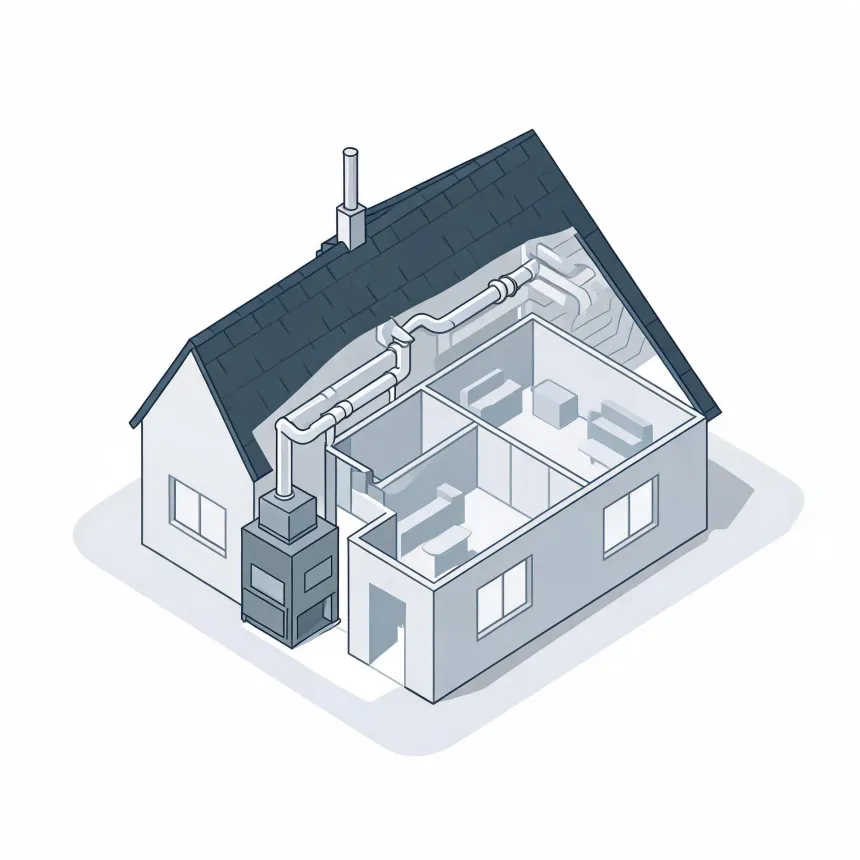
Isometric line illustration of a cutaway single-story house with a dark shingled roof, showing interior rooms and ductwork connected to a gray furnace unit with a flue pipe.
Your furnace works hardest from November through March.

NOAA nClimDiv, 1991–2020 normals

October is when Warren County furnaces fire up again after sitting idle since spring.

A weak igniter or a cracked heat exchanger often waits until that first cold week in October to show itself.

Half the homes here are new enough that this furnace still has years left in it

Half the homes here were built by 1985
Heat runs October through May
Winter nights average 17°F

If the furnace came with the house and the house was built more recently, that furnace is probably not old enough to be failing from age alone. A repair makes sense in that case. Whatever is wrong, a cracked heat exchanger, a bad igniter, a failing blower motor, is more likely a single part giving out than the whole unit reaching the end of its life. Replacing a furnace that still has years left in it costs you those years. Worth asking the contractor how old the unit actually is before deciding what to do.

A furnace that runs eight months a year is worth diagnosing properly

Whatever part is giving out has been under load since October. Have it looked at by someone who checks the actual part instead of guessing, so the repair holds.

Find a contractor
A man in a gray polo shirt and tan work pants carries a worn canvas tool bag up porch steps toward a closed gray front door, with a potted shrub beside the entry.
A gas furnace with attached ductwork, gas piping, and condensate lines installed in a concrete-block basement.

What a furnace tells you before it quits

A furnace short cycles, running for a few minutes and shutting off before the house warms up. That points to a clogged filter, a cracked heat exchanger tripping a safety switch, or a flame sensor that is not reading the flame right. A furnace that runs and runs without ever hitting the set temperature usually means a blower that cannot push enough air, or ductwork problems further down the line. Listen for the bang at startup. That is gas building up before it lights instead of catching right away, and it means the burners need attention. A clicking igniter that never catches, or a hum from the blower motor that never turns into a spin, both mean a part is failing even though the furnace is still technically running. Yellow flame instead of blue is not cosmetic. It usually means the gas is not burning clean, and that is not something to wait on. None of these are things to diagnose from the couch. They are reasons to get the panel off and the part tested.

Most failures are one part, not the whole system

A furnace is a chain of parts that each have to work for the thing to run: an igniter to light the gas, a flame sensor to confirm it caught, a blower motor to push the air, a heat exchanger to warm it safely. When a furnace quits, it's almost always one of these failing on its own, not everything wearing out together. Finding which one is the job.

Age and neglect fail a furnace differently

An igniter or flame sensor just wears out from years of heating and cooling every time the burners fire. A dirty filter or blocked vent fails a furnace a different way, by starving it of airflow or combustion air until something downstream overheats or trips a safety switch. Both end with a furnace that won't run right, but one is routine wear and the other is upkeep that got missed.

A gray forced-air furnace with ductwork stands in an unfinished concrete basement surrounded by storage items and clutter.

A new furnace would cut about $100 a year off heating for a typical Warren County home.

  • A new high-efficiency furnace$410 a year
  • An older furnace$510 a year

Estimates for a typical Warren County home, compared with an older unit built to the previous federal minimum, from EIA household energy data, Iowa fuel prices and NOAA climate normals. Your home will differ.

Repair makes sense when one part has failed and the heat exchanger is sound.

Replacement makes sense when the heat exchanger is cracked or the furnace keeps needing parts.

Repair versus replacement comes down to one question: is it just this part, or is it the whole unit. A furnace near the end of its life tends to fail in more than one way around the same time. The igniter goes, and the blower bearing is already making noise, and the heat exchanger is starting to rust through. That pattern means the next repair is never really the last one. A furnace that is otherwise sound and just had one part give out is a different case entirely. Swap the part, and there is no reason the rest of the unit cannot keep running for years. The question to ask is not just what broke, but whether other parts nearby are close behind it.