


A dark two-story house with a covered front porch and shrubs, framed by large leafy trees, photographed from ground level across a mown green lawn with blurred grass in the foreground.

Furnace Repair in Sioux Center, IA

Tell us about the job

Takes about a minute. No obligation.

RepairFurnace or heatingSioux County, IA
Step 1 of 2

What ZIP code is the job in?

Furnaces around Sioux Center run from October through May, about eight months of the year. That's most of the year spent cycling on and off, pushing heat through a house in weather that doesn't let up. Between 2015 and 2024, Sioux County saw 37 winter storms, and each one means hours of hard running to hold the house at temperature. A furnace built for that kind of workload still has an igniter, a blower motor, a flame sensor, parts that wear with use. When one starts acting up here, it's often just the schedule catching up with the machine, not something installed wrong or treated badly.

8 months
October through May, your furnace is on duty
11°F
the average winter night it heats against
37 winter storms
in ten years, the nights a failure hurts most
Isometric cutaway illustration of a house showing interior rooms with furniture, a furnace unit with a tall flue pipe outside, and ductwork running through the attic.
Your furnace works hardest from November through March.

NOAA nClimDiv, 1991–2020 normals

Half the homes around Sioux Center were built in 1973 or earlier.

A furnace in one of those houses may be on its second or third unit already, and age adds up fast on top of a hard winter workload.

Eight months of heat means the first cold snap finds whatever was already wearing thin

Heat runs October through May
Climate zone 6A
Winter nights average 11°F

If your furnace came with a house built in 1973 or earlier, ask the contractor straight out whether this repair is worth it. A unit that old has likely been replaced once already, sometimes twice, and a repair bill on a machine near the end doesn't buy you much. Get a read on what's left in it before deciding what to spend. Sometimes the honest answer is a smaller fix gets you through this winter fine. Sometimes it isn't.

Get the furnace looked at before the next cold snap tests it

A furnace that's struggling after eight months of steady running isn't necessarily failing, but it needs a real look to know which one it is. A contractor can tell you whether this is a worn part doing what worn parts do, or something bigger. Get it checked before the next storm asks more of it than it has to give.

Find a contractor
A man in a dark t-shirt and tan work pants, seen from behind, carries a worn canvas and leather tool bag up concrete steps toward a dark gray front door, with a potted flowering plant to the right.
A gray residential gas furnace installed in an unfinished basement, surrounded by ductwork, a metal flue pipe, and a gas supply line.

What to check before you pick up the phone

Before anyone comes out, there are a few things worth checking. Look at the thermostat first. Make sure it's set to heat and not fan, and that the temperature is actually set above room temperature. A dead thermostat battery can make a furnace act like it's not responding at all. Next, check the air filter. A filter clogged with dust chokes off airflow, and a furnace that can't breathe will shut itself down or blow cold air to protect itself. If you can see light through it, it's fine. If you can't, swap it. Then check the breaker panel. A furnace that won't start at all sometimes just tripped a switch. Reset it once. If it trips again, stop and leave it alone. Walk over to the furnace itself and look for a flashing light near the bottom, behind a small window on the control board. That blink pattern means something specific to whoever built the unit, and it tells a tech what's wrong before they even open the panel. Don't try to decode it yourself, just note how many times it flashes. Last, check that the vent pipe outside hasn't been blocked by anything. A blocked vent can shut a furnace down on purpose, and that's not a part to force back open.

A furnace rarely quits without warning first

Short cycling, where it fires up and shuts off before the house warms, usually means a cracked heat exchanger tripping a safety switch or a flame sensor too coated to hold a signal. A burner that won't stay lit, air coming out lukewarm instead of hot, or a blower that runs on after the house is warm all point to a part failing partway rather than all at once. A loud bang at startup is delayed ignition, gas pooling before it catches, and that one is worth shutting down for until someone looks at it.

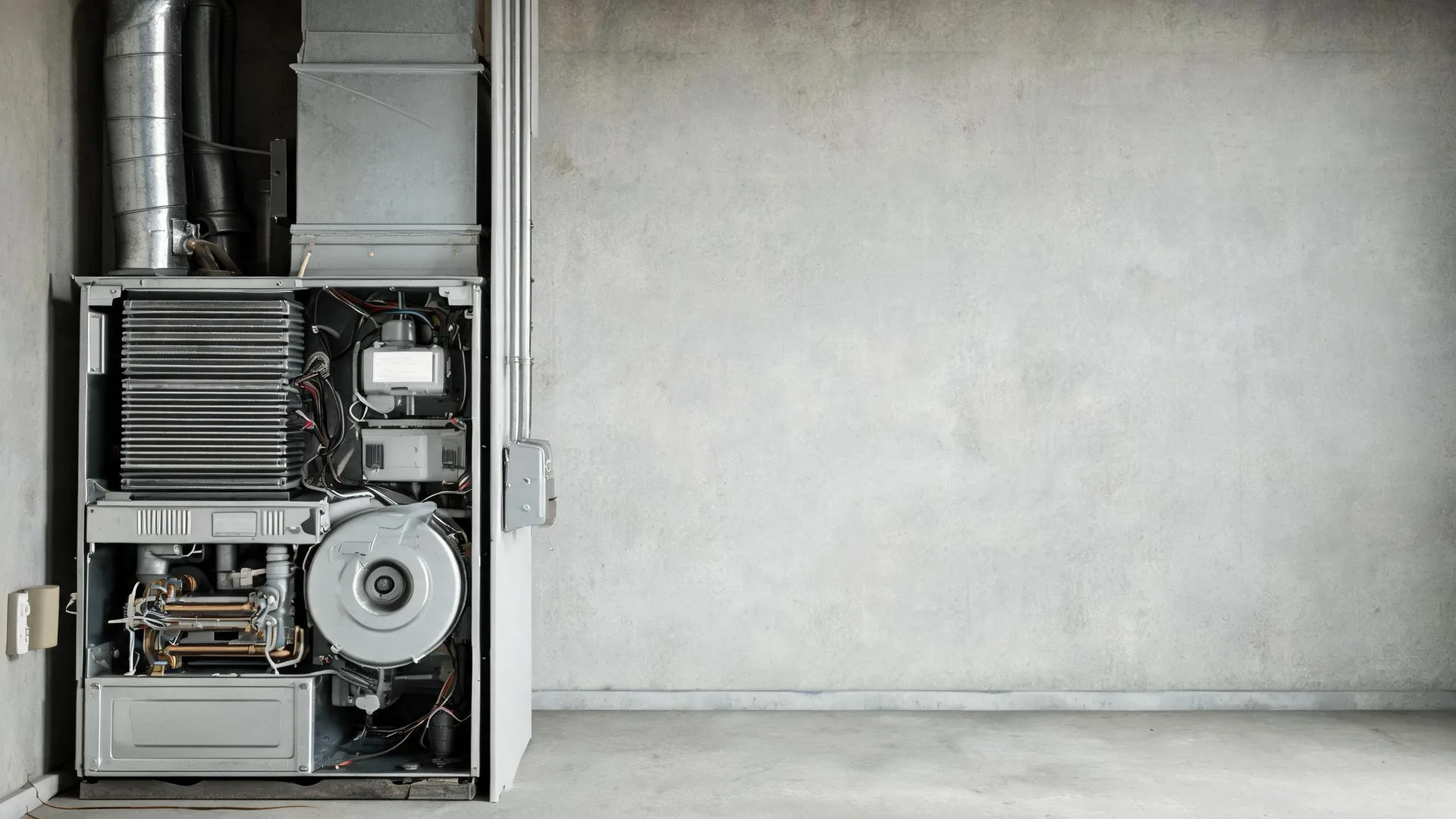
Waiting usually costs more than the repair itself

A furnace making a new noise or smell is already telling you something broke loose or burned. Rattling can be a loose panel, or it can be a blower wheel coming off balance, and only one of those is simple. A burning smell at startup usually clears on its own as dust burns off the heat exchanger, but a smell that lingers or smells electrical means stop running it and get it looked at. Small failures tend to drag other parts down with them the longer they run unfixed.

An unfinished basement interior showing a gray furnace unit beneath a bare incandescent bulb, surrounded by exposed joists, concrete walls, cardboard boxes, and utility pipes.

A new furnace would cut about $120 a year off heating for a typical Sioux County home.

  • A new high-efficiency furnace$490 a year
  • An older furnace$610 a year

Estimates for a typical Sioux County home, compared with an older unit built to the previous federal minimum, from EIA household energy data, Iowa fuel prices and NOAA climate normals. Your home will differ.

Repair makes sense when one part has failed and the heat exchanger is sound.

Replacement makes sense when the heat exchanger is cracked or the furnace keeps needing parts.

A diagnostic visit starts before any panel comes off. A tech will ask what the furnace was doing, when it started, and whether anything changed right before it did, since that often narrows things down fast. Then they pull the cover and check the obvious parts first: flame sensor, igniter, pressure switch, the wiring between the control board and the blower. Most will run the furnace through a full cycle on purpose, watching it fire, stay lit, and shut down, because some problems only show up partway through a cycle. They'll check gas pressure and look at the flame itself, since the color and shape tell a trained eye things a reading on a gauge won't. If the blink code on the control board pointed to something specific, that's where they start, but they won't stop there if the real problem turns out to be upstream of it. By the end, you should get a straight answer on what's failing, why, and what happens if it's left alone.