A row of dark-clad houses with gray gabled roofs behind trimmed hedges and a lawn, framed by overhanging tree branches under an overcast sky.

Heat Pump Repair in Waterloo, IA

Tell us about the job

Takes about a minute. No obligation.

RepairHeat PumpBlack Hawk County, IA
Step 1 of 2

What ZIP code is the job in?

September is when a weak heat pump shows itself

Heat here runs October through May, about eight months straight. When a heat pump switches over to heat for the season, whatever was already marginal, a weak capacitor, a low charge, a failing board, tends to give out under the new load. If yours is acting up in September, that's the reason why.

Catching it before October matters

A heat pump struggling before the switchover is easier to diagnose than one that's been running flat out for weeks. Once the system settles into eight months of steady heating, a small problem gets more time to turn into a bigger one. Getting it looked at now means the cause gets found while it's still simple.

8 months
October through May, your system heats
3 months
June through August, it cools
13°F
the average winter night it heats against
82°F
the average summer afternoon it cools against
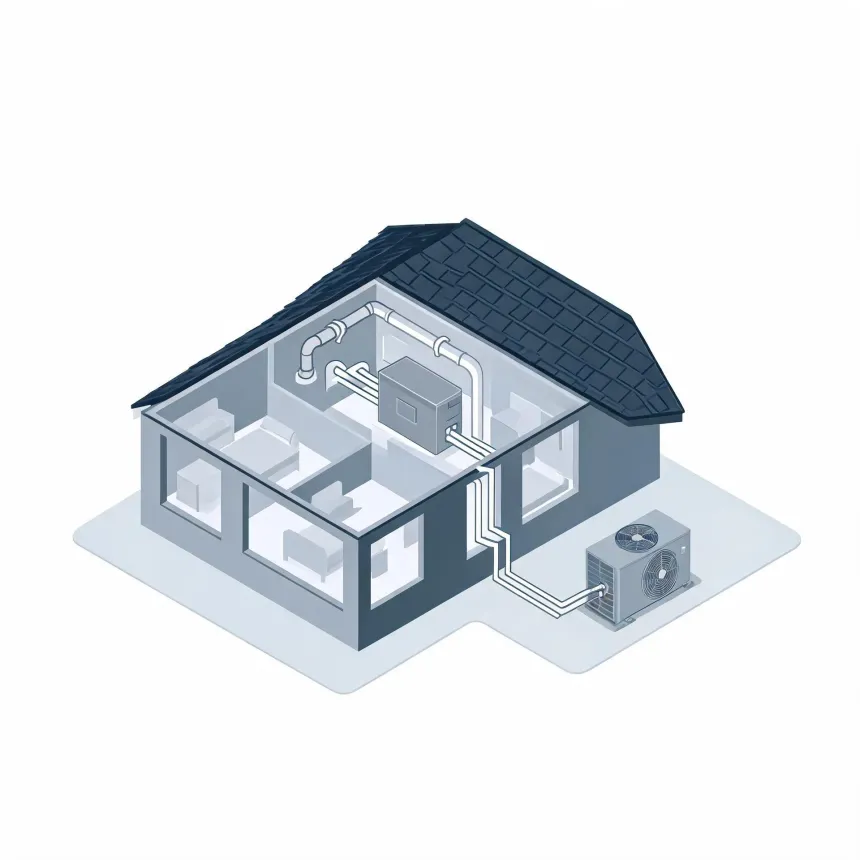
Isometric cutaway illustration of a gray house showing interior rooms, a central air handler with ducts in the attic, and refrigerant lines running to an outdoor condenser unit beside the building.
Your system heats October through May and cools June through August.

NOAA nClimDiv, 1991–2020 normals

Black Hawk County sees its share of wind, hail and winter storms, same as the rest of the area.

None of that is why your heat pump is acting up. It's almost always a part inside it giving out, not the weather outside it.

Black Hawk County weather is normal for Iowa, and that's the point

142 severe weather events from 2015 to 2024
15% of homes statewide lost power a day or more in 2024
62 damaging wind events from 2015 to 2024
A heat pump that's struggling costs you every month it runsIowa households paid 13.40 cents per kilowatthour in 2024

Half the homes in Black Hawk County were built in 1966 or earlier. If your heat pump came with a house that old, there's a decent chance the unit itself has been swapped out since, but there's no way to know that from the house alone. Worth checking the nameplate or asking whoever installed it, if you know. An older home isn't what's hard on a heat pump. What matters is how long the unit itself has been running. A repair on a system with years left in it is a different call than the same repair on one that's near the end.

A struggling heat pump costs you every day you wait

A heat pump working harder than it should runs up your bill every day it's left that way. Electricity here runs 13.40 cents per kilowatthour, and a struggling unit burns through more of it than it should. Getting the actual cause found and fixed is what stops that.

Find a contractor
A gray heat pump outdoor unit mounted on a concrete pad next to the stone-accented exterior wall of a house.

Check the nameplate before you decide

Find the nameplate before anyone comes out. It has the model and serial number, and whoever installed it can usually pin down the age from that. If the unit is old and on its way out, that's worth knowing before paying for a repair. If it's newer than the house, a repair makes a lot more sense.

It won't switch between heating and cooling

A heat pump that's stuck in one mode, or won't reverse when you change the thermostat, usually has a problem with the reversing valve or the solenoid that controls it. Blowing cold air when it should be heating, or the outdoor unit running nonstop without catching up, points the same direction.

It's running constantly or short cycling

A heat pump that never shuts off, or one that kicks on and off every few minutes, is telling you it can't reach the temperature it's set to or it's shutting down on a safety switch. Either way the system is working harder than it should and something inside it is why.

Before anyone comes out, there are a few things worth looking at yourself. Check the thermostat first. Make sure it's set to heat and the temperature is actually above room temperature, since a setting bumped by accident looks exactly like a broken system. Look at the outdoor unit and clear away any leaves, ice or snow built up around it, since a blocked unit can't move air the way it needs to. Check the air filter and swap it if it's dirty, because restricted airflow makes a heat pump struggle in ways that mimic bigger problems. Go around the house and make sure no vents are closed or blocked by furniture. Check the breaker box too. A tripped breaker will shut the whole system down and reset with a simple flip. None of this fixes a bad capacitor or a reversing valve stuck in the wrong position, but it rules out the simple stuff before you pay someone to find it for you.

A diagnostic starts with the thermostat call, heat, cool, fan, and whether the unit actually responds to it. From there the tech checks refrigerant pressures, because a low charge shows up as weak heating, poor cooling, or ice on the outdoor coil. They'll test the capacitor and the contactor, since those wear out and take the compressor or fan motor down with them when they fail. The reversing valve gets checked too, especially if the system is stuck in one mode. Electrical connections get a look, because a loose or corroded wire can cause the same symptoms as a failed part. By the end you should know which part is bad, not just that something is wrong.