



A dark horizontal-sided building corner in the left foreground beside a mowed lawn, with a light-colored single-story house and large deciduous trees under a pale sky in the background.

Heat Pump Repair in Clinton, IA

Tell us about the job

Takes about a minute. No obligation.

RepairHeat PumpClinton County, IA
Step 1 of 2

What ZIP code is the job in?

Winter here is the real test for a heat pump. Nights in Clinton County average 16°F across December, January and February, and that's exactly when a struggling unit shows its weaker side. It might run long cycles. It might lean hard on the backup heat strip. None of that means your system is overmatched. Zone 5A calls for a heat pump built to handle real cold, and most are. If yours is losing the fight, the cause is usually something a technician can find fast, like low refrigerant, a failing defrost control, or a reversing valve stuck partway open. Nothing here is unusual for the machine. It just needs the right diagnosis.

8 months
October through May, your system heats
3 months
June through August, it cools
16°F
the average winter night it heats against
82°F
the average summer afternoon it cools against
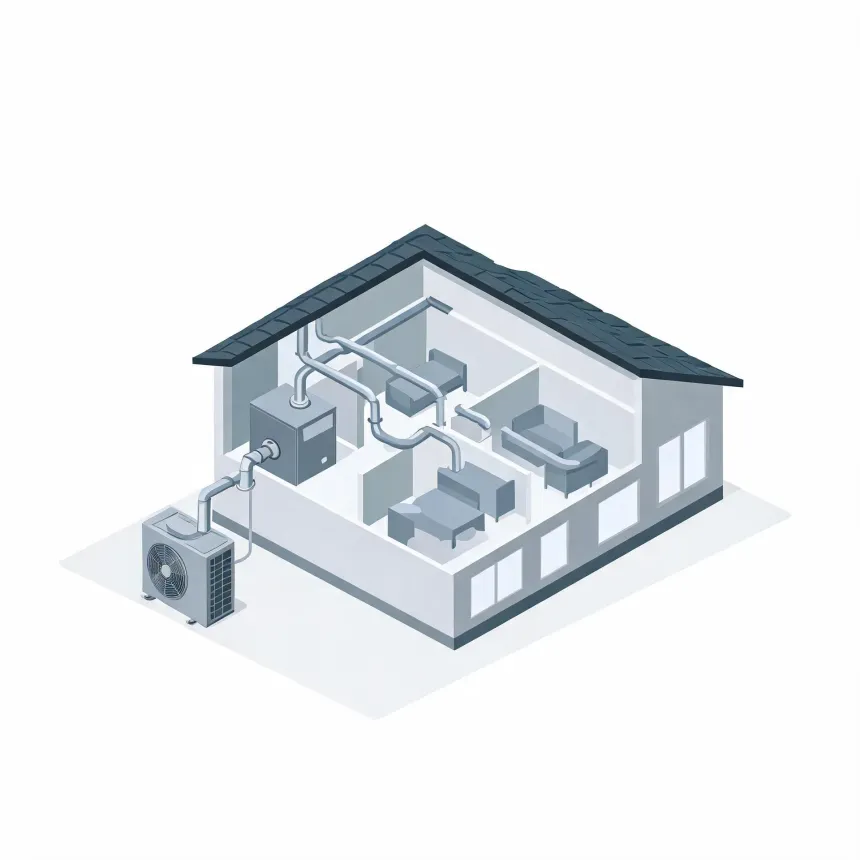
Isometric cutaway illustration of a single-story house showing an indoor air handler, branching ductwork through rooms with furniture, and an outdoor condenser unit connected by a line outside the wall.
Your system heats October through May and cools June through August.

NOAA nClimDiv, 1991–2020 normals

Your heat pump switches over and starts carrying the heat load in October.

If a part was already weak, September is when to catch it, before the first cold night makes it worse.

Clinton County weather doesn't wear out a heat pump faster. A worn part does.

171 severe weather events from 2015 to 2024
15% of homes statewide lost power a day or more in 2024
75 damaging wind events from 2015 to 2024

Half the homes in Clinton County were built in 1957 or earlier. If your heat pump came with a house from around that time, the system itself is almost certainly newer than the house, but it's worth finding out how old it actually is. A heat pump has a limited number of years before the compressor wears out or the repairs stop being worth it. That's worth knowing before you put money into a big fix. Ask the technician how many years the unit has left in it, not just what's wrong with it today.

Find the real cause, and the fix holds

Get the right part fixed once, and your heat pump runs on what it's always run on. Iowa homes paid 13.40 cents per kilowatthour in 2024, and that number doesn't change because a reversing valve is stuck or a defrost control is failing. Fix the actual cause and the cost of running it goes back to normal.

Find a contractor
A gray heat pump outdoor unit mounted on a concrete pad next to a residential house with lap siding and stone accents.

Most failures trace back to something that made the compressor work too hard

A heat pump fails the same ways most years, not because of one bad winter. The compressor is the part everything depends on, and it usually goes because something else made it work harder than it should have for a long stretch. A dirty outdoor coil, a low charge, a stuck valve, any of those forces longer runtimes and higher head pressure, and the compressor just wears faster under that load. Contactors and capacitors fail on their own timeline, pitting or losing capacitance after enough start cycles, and that's usually a quick fix if it's caught before the compressor tries to start without it. Defrost boards and sensors cause more no-heat calls than people expect, since a board that won't trigger defrost lets ice build until airflow stops entirely. The parts that fail young are almost always the ones doing the most switching and starting. The ones that fail old are the ones that were quietly overworked for years first.

A stuck reversing valve wears the compressor faster

When the reversing valve won't fully switch, the compressor ends up fighting itself, pushing refrigerant against pressure it wasn't meant to work against. Left alone, that extra strain is exactly what shortens a compressor's life. Shutting the system down and getting the valve looked at stops that wear where it is instead of letting it compound.
Low refrigerant lets the compressor run hot

A heat pump low on charge still tries to meet the thermostat, so the compressor runs longer and runs hotter than it was built to. That heat breaks down the oil that's supposed to keep the compressor's internal parts moving freely. Once that happens, the damage doesn't undo itself just because the charge gets topped off later.

Before anyone comes out, there are a few things worth checking yourself. Look at the outdoor unit. If the coil is caked in ice or buried in leaves and debris, airflow is choked and the system can't move heat the way it should. Check the thermostat is actually set to heat and the temperature is set above room temperature, not sitting at the same number. Go to the vents and feel for airflow. Warm air from a heat pump is never as hot as a furnace, so lukewarm is normal, but no airflow at all usually means a blower problem. Check the breaker panel for a tripped breaker, since a heat pump that stopped dead sometimes just lost power. If the outdoor unit is running constantly and never shuts off, or if you hear it cycling between heating and a loud defrost mode over and over, that's not something to fix yourself. Those point to a refrigerant or control problem a technician needs to see firsthand.

A diagnostic visit starts outside, at the unit itself. A technician checks refrigerant pressure, since that number alone can point to a leak or a failing metering device. They test the reversing valve by forcing a switch between heating and cooling, listening and feeling for whether it actually moves or just hums. They check the defrost cycle, since a sensor or control board that misreads coil temperature will either skip defrost when it's needed or run it when it isn't. Electrical readings on the compressor come next, because a motor drawing too much current is often close to failing even if it still runs. None of this takes guesswork. Each test rules something in or out, and by the end there's a clear answer on what's actually wrong, not just what might be.