

Dark-sided single-story buildings with gray shingled roofs behind trimmed hedges, a mown lawn, and large leafy trees overhead.

Heat Pump Repair in Council Bluffs, IA

Tell us about the job

Takes about a minute. No obligation.

RepairHeat PumpPottawattamie County, IA
Step 1 of 2

What ZIP code is the job in?

A heat pump in Pottawattamie County works for eight months straight, October through May, then switches over and runs cooling in the four months after. That switchover is when a weak part tends to fail. September is the last easy month before heat season starts, and it's the better time to find a capacitor or contactor that's already struggling, before the system has to carry the full load of a cold morning. Same with May, before cooling starts. If your heat pump is acting up right at the start of a season, that's not bad luck. That's a part that was already on its way out, and the first real demand on it finished the job.

8 months
October through May, your system heats
4 months
June through September, it cools
16°F
the average winter night it heats against
84°F
the average summer afternoon it cools against
Isometric line illustration of a cutaway single-story house showing interior rooms with furniture and attic ductwork connected to an outdoor condenser unit beside the building.
Your system heats October through May and cools June through September.

NOAA nClimDiv, 1991–2020 normals

A capacitor or contactor wears out from ordinary use, cycling on and off for years until one of them finally gives.

A failure like that shows up fast, usually as a system that won't start at all, so it's rarely a mystery once a contractor gets eyes on it.

Half the homes in Pottawattamie County were built in 1967 or earlier. A heat pump doesn't last that long, so if yours came with the house, it's not original equipment. It's at least a few replacements in. That matters when you're deciding whether to fix what's broken now or ask more questions first. A system nearing the end of its life can keep failing in different spots, one repair after another, each one a smaller version of the same decision. Before paying for a big repair, it's worth finding out how much life is actually left in it.

Get the real cause found and fixed

A heat pump breaking down isn't a sign of anything unusual here. It's a part that gave out, and a contractor can find which one and fix it. Electricity in Iowa runs 13.40 cents per kilowatt-hour, so a heat pump that's losing efficiency because of that worn part is costing more to run than it should every day it's left alone.

Find a contractor
A gray outdoor HVAC unit mounted on a concrete pad beside a house with gray lap siding and a stone foundation.

The hours it's already logged

A heat pump logs thousands of hours a year, every year it's in service, and those hours add up faster the older the system is. If yours is original to a house built decades back, ask the contractor for its age and condition before agreeing to a repair past a certain size. Find out whether it's worth putting more money into.

What you can look at yourself

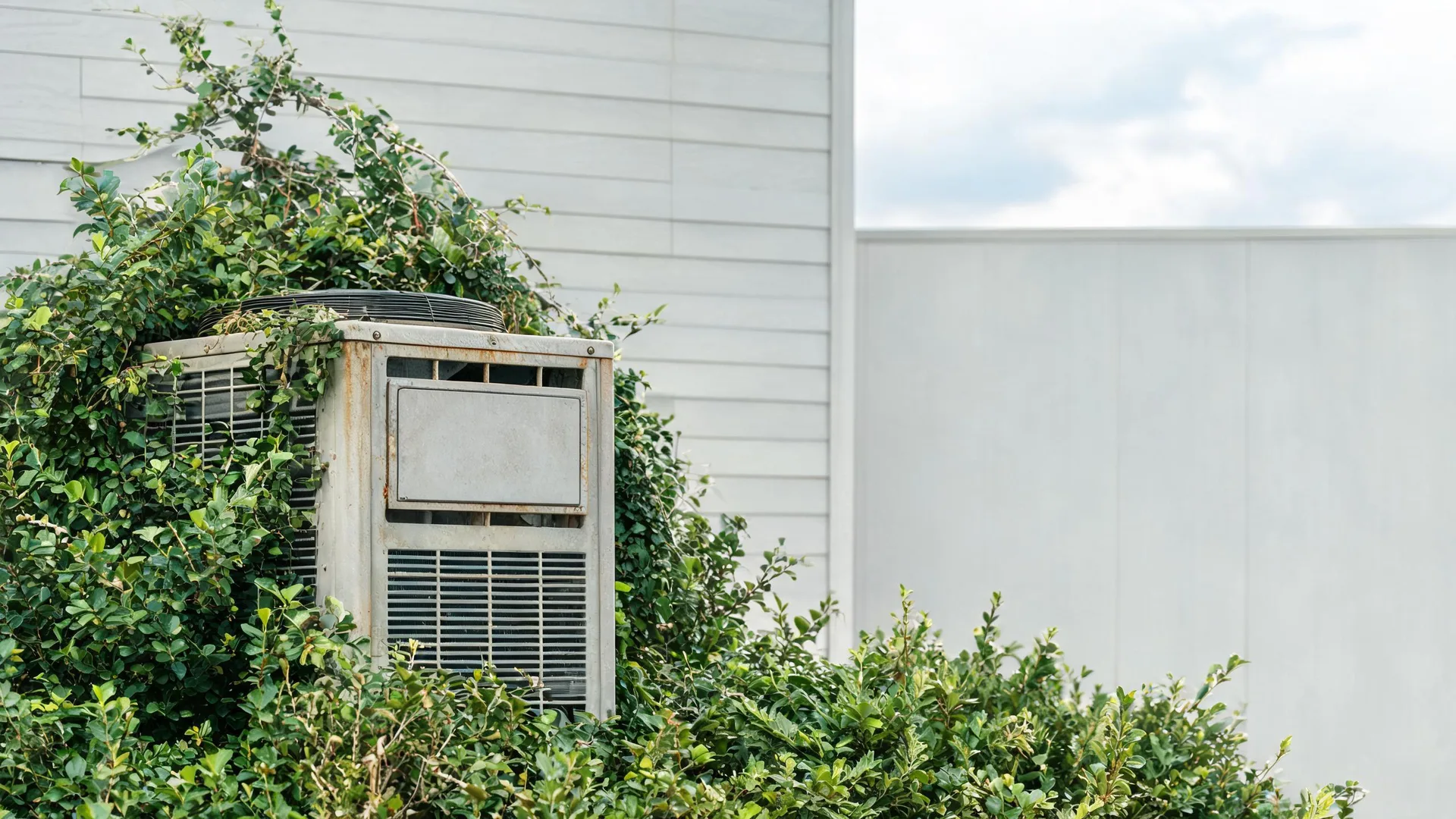
Check the filter first. A clogged filter starves the system of airflow and can make it ice up or shut itself down. Look at the outdoor unit too. Leaves, snow or ice packed around the coil block airflow the same way a dirty filter does, so clear anything piled against it and make sure the fan isn't obstructed. Check the thermostat is set to the right mode and that its batteries are good if it takes any. Walk your breaker panel and see if the breaker for the outdoor unit has tripped.
What to leave alone

Don't open the outdoor unit's cabinet or touch anything inside it. The refrigerant lines and electrical connections in there aren't something to test or adjust yourself. If you see ice built up on the coil, don't chip at it or pour water on it to melt it off. If the system is making a grinding or screeching noise, or a breaker keeps tripping when you reset it, turn the system off at the thermostat and leave it off until a contractor looks at it. Running it in that state tends to turn one bad part into damage somewhere else.

Short cycling is one of the clearer signs something's wrong. The system kicks on, runs a few minutes, shuts off, then starts again before the house has actually warmed or cooled. That's usually a thermostat problem, a refrigerant charge that's off, or a compressor struggling to stay running. Warm air blowing in heating mode, or air that never feels quite cold enough in summer, points at the reversing valve that's supposed to switch the system between modes. If that valve sticks, the system runs backward or won't switch at all. Ice building up on the outdoor coil during a heating cycle and not clearing during defrost is another one worth noting, since that cycle is supposed to run on its own on a schedule. And a system that runs constantly without ever satisfying the thermostat is often low on refrigerant, losing the charge it needs to move heat either direction.

A diagnostic visit starts outside, at the unit itself. A contractor checks refrigerant pressures on both the high and low side. That tells them whether the charge is right and whether the compressor is pulling load the way it should. They'll check the reversing valve directly, since a valve that's sticking doesn't always show it on every cycle. Then come the electrical readings. The capacitor's output, the contactor's condition, the amp draw on the compressor and the fan motor. A contractor will also pull the cover and look at the wiring and connections for anything scorched or loose, since heat and vibration work on those joints over years of runtime. Inside, they're checking airflow across the coil and the temperature split between return and supply air, because a system can have the right charge and still perform poorly if air isn't moving through it properly.