





A mowed lawn bordered by a tall trimmed hedge, with single-story houses and large leafy trees under an overcast sky.

Heat Pump Repair in Iowa City, IA

Tell us about the job

Takes about a minute. No obligation.

RepairHeat PumpJohnson County, IA
Step 1 of 2

What ZIP code is the job in?

A heat pump in Johnson County works about eight months a year, October through May, then switches over and runs cooling in June. That changeover is when trouble tends to show up. A component that limped through a mild September can fail outright the first cold week of October, once the system has to carry real heat for hours at a time. Same thing in reverse come June, right after a slow stretch in May. If your heat pump is struggling right as the season turns, that timing is not a coincidence, and it is worth having someone look at it before the next run of hard weather finds the same weak part again.

8 months
October through May, your system heats
3 months
June through August, it cools
16°F
the average winter night it heats against
83°F
the average summer afternoon it cools against
Isometric grayscale illustration of a cutaway house showing interior rooms, ductwork and an indoor air handler connected by lines to an outdoor condenser unit on the ground outside.
Your system heats October through May and cools June through August.

NOAA nClimDiv, 1991–2020 normals

Johnson County winters sit around 16°F overnight, a normal cold load for a heat pump to carry.

So when yours is struggling, the cause is almost always a worn part doing its usual job in the cold, not the weather being unusual.

Half the homes here were built by 1992, so a lot of heat pumps still have years left in them

Half the homes here were built by 1992
87 damaging wind events from 2015 to 2024
71 hail events from 2015 to 2024

Your heat pump is probably worth fixing

A heat pump that came with a newer house still has most of its working life ahead of it. Get the actual part diagnosed and repaired rather than planning around a replacement.

Find a contractor
A man in a cap, long-sleeved shirt and work pants walks up porch steps toward a dark gray paneled front door, carrying a canvas tool bag, with a potted shrub to the right.
A gray outdoor HVAC unit mounted on a concrete pad beside a house with gray lap siding and a stone foundation.

What to check before anyone comes out

Before anyone comes out, there are a few things worth checking yourself. Go outside and look at the outdoor unit. If it's caked in ice or snow, that's worth noting, but don't chip at it or hose it down. Check that nothing is piled against it, no leaves, no snow drift, nothing blocking airflow on any side. Inside, check your thermostat has fresh batteries if it takes them, and that it's actually set to heat or cool, not sitting in some fan-only mode by accident. Pull the air filter and hold it up to a light. If you can't see light through it, swap it or clean it, a clogged filter can make a heat pump run constantly without ever catching up. Walk the vents in the house and make sure none are closed or blocked by furniture or rugs. Check the breaker panel for a tripped breaker while you're at it, heat pumps pull on a dedicated circuit and a tripped breaker will shut the whole thing down with no other warning. None of this fixes a bad capacitor or a stuck reversing valve, but it rules out the simple stuff before anyone opens a panel.

Most failures are a handful of parts wearing out

The capacitor that kicks the compressor and fan on weakens over time and eventually won't deliver the jolt needed to start them. The contactor that switches power to the outdoor unit pits and burns with every cycle until it sticks or stops conducting. The reversing valve that switches between heat and cool can stick partway, leaving the system blowing the wrong temperature air or neither. Refrigerant charge drops only through a leak, never through normal use, so a low charge always points to a leak somewhere in the lines or coil.
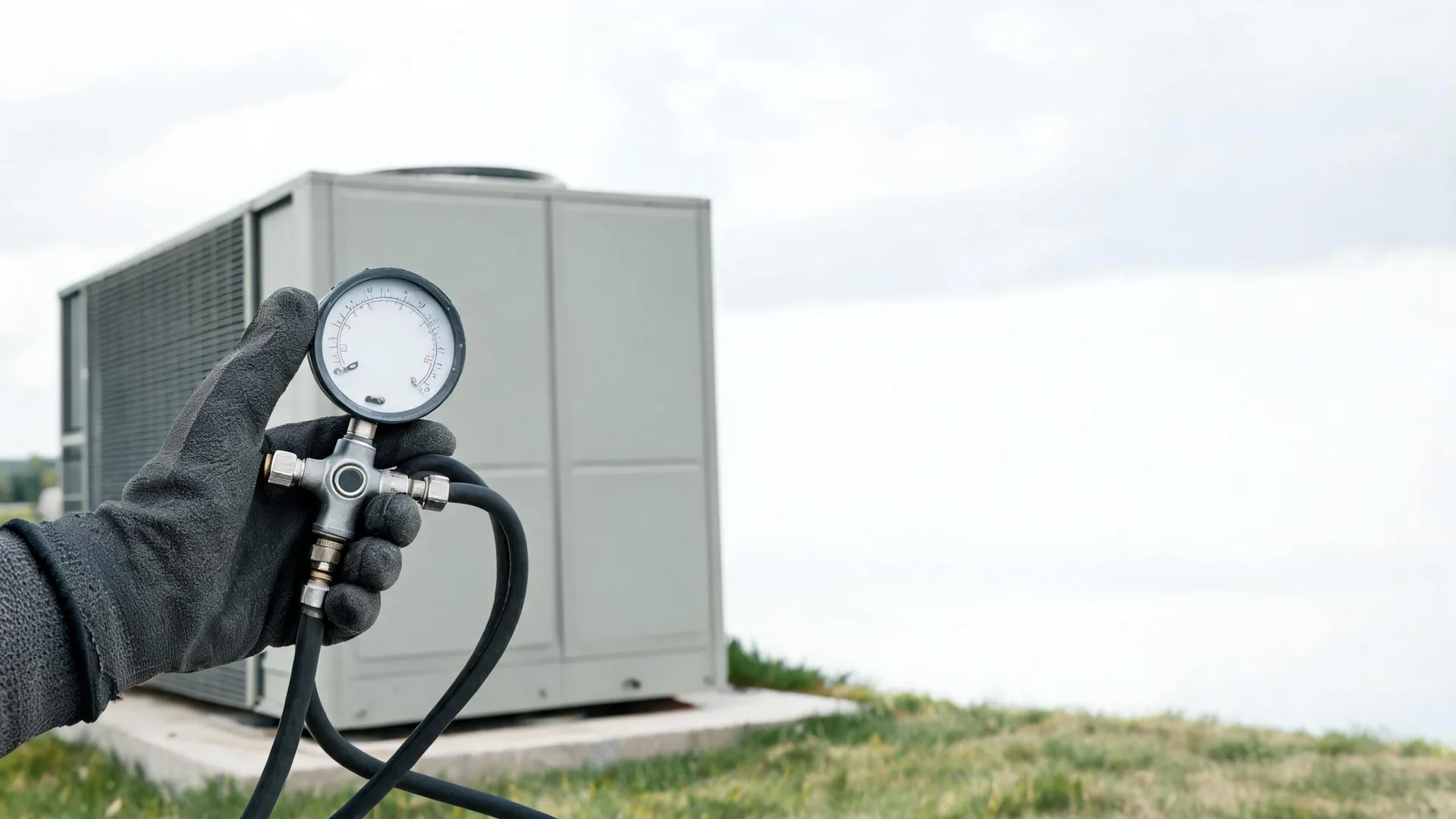
The defrost cycle is where heat pumps show their age

A heat pump has to melt frost off the outdoor coil periodically through the cold months, and that cycle depends on a sensor reading coil temperature and a board deciding when to reverse into defrost. When that sensor drifts or the board logic fails, frost builds up unchecked and the coil ices over solid, which chokes airflow and drags down heating capacity. A unit that worked fine in the shoulder months can fail here first, since light frost never pushed the defrost system hard enough to expose a weak sensor or a sticking valve.

A heat pump that cannot heat or cool right is usually losing a fight against something else, and running it anyway tends to let that something else win. Low refrigerant charge is the clearest case. The compressor is built to pump a certain amount of refrigerant, not air, and when the charge is low it starts pumping some amount of refrigerant vapor instead, which runs hotter and carries less lubricant to the moving parts inside. Keep that up for days instead of hours and the compressor wears against itself in a way it was never meant to. A failing capacitor tells a similar story. It gets weaker on every start, and a motor that starts hard and slow pulls more current than it should every single cycle, which stresses the windings a little more each time. A stuck reversing valve or an iced-over outdoor coil can both make the system run constantly without actually heating the house, and a compressor laboring nonstop under those conditions is working harder for less result than one that gets to shut off and rest on a normal cycle. None of these problems announce themselves loudly at first. They just mean the parts underneath are absorbing damage every hour the system keeps trying.

Whether a heat pump is worth fixing usually comes down to which part failed, not how old the system looks from outside. A capacitor, a contactor, a defrost sensor, a reversing valve, these fail on their own schedule and get swapped out one at a time without touching anything else. A compressor is different. It's sealed into the outdoor unit, so a compressor failure is really a replacement question rather than a repair, and that's the one case where the rest of the system's condition starts to matter. Most service calls never get there. A worn contactor or a weak capacitor is a straightforward fix regardless of how long the unit has been running. The question worth asking once someone's traced the problem to its source isn't the heat pump's age, it's whether what failed is a part or the compressor itself.