






A nighttime view of a tree-lined residential street with illuminated two-story brick houses and street lamps.

Heat Pump Repair in Newton, IA

Tell us about the job

Takes about a minute. No obligation.

RepairHeat PumpJasper County, IA
Step 1 of 2

What ZIP code is the job in?

Newton sits in zone 5A, a cool climate where heating carries most of the load over the year. Winters push a heat pump harder than summers do, and overnight lows here average 16°F across December, January and February. That's normal for this area, not a sign of a harsh climate wearing on your system. If it's blowing cool air, short cycling, or running nonstop without catching up to the thermostat, the cause is usually something straightforward. Low refrigerant, a stuck reversing valve, or a defrost cycle that isn't kicking in are the common culprits. A contractor checking the system can narrow it down and fix the actual problem instead of guessing.

8 months
October through May, your system heats
3 months
June through August, it cools
16°F
the average winter night it heats against
83°F
the average summer afternoon it cools against
Isometric line illustration of a cutaway house showing interior rooms with furniture, ceiling ductwork, and an outdoor condenser unit connected by lines along the exterior wall.
Your system heats October through May and cools June through August.

NOAA nClimDiv, 1991–2020 normals

Half the homes in Jasper County date to 1965 or earlier

Half the homes here were built by 1965
54 hail events from 2015 to 2024
20 winter storms from 2015 to 2024
Iowa electricity runs 13.40 cents a kilowatt-hourA heat pump working harder than it should shows up fast on the bill.

If your heat pump came with a house built decades ago, it's worth finding out how old the system itself is before paying for a repair. Plenty of homes here have had their heating replaced since the house went up, so the house's age alone doesn't tell you much. But if nobody's touched it since, a reversing valve or compressor problem is a different call on an old system than on a new one. A contractor can tell you what's actually in there and how much life it has left before you commit to fixing it.

Get the usual fix

Nothing about this area is especially hard on it. It's most likely the usual problem with the usual fix.

Find a contractor
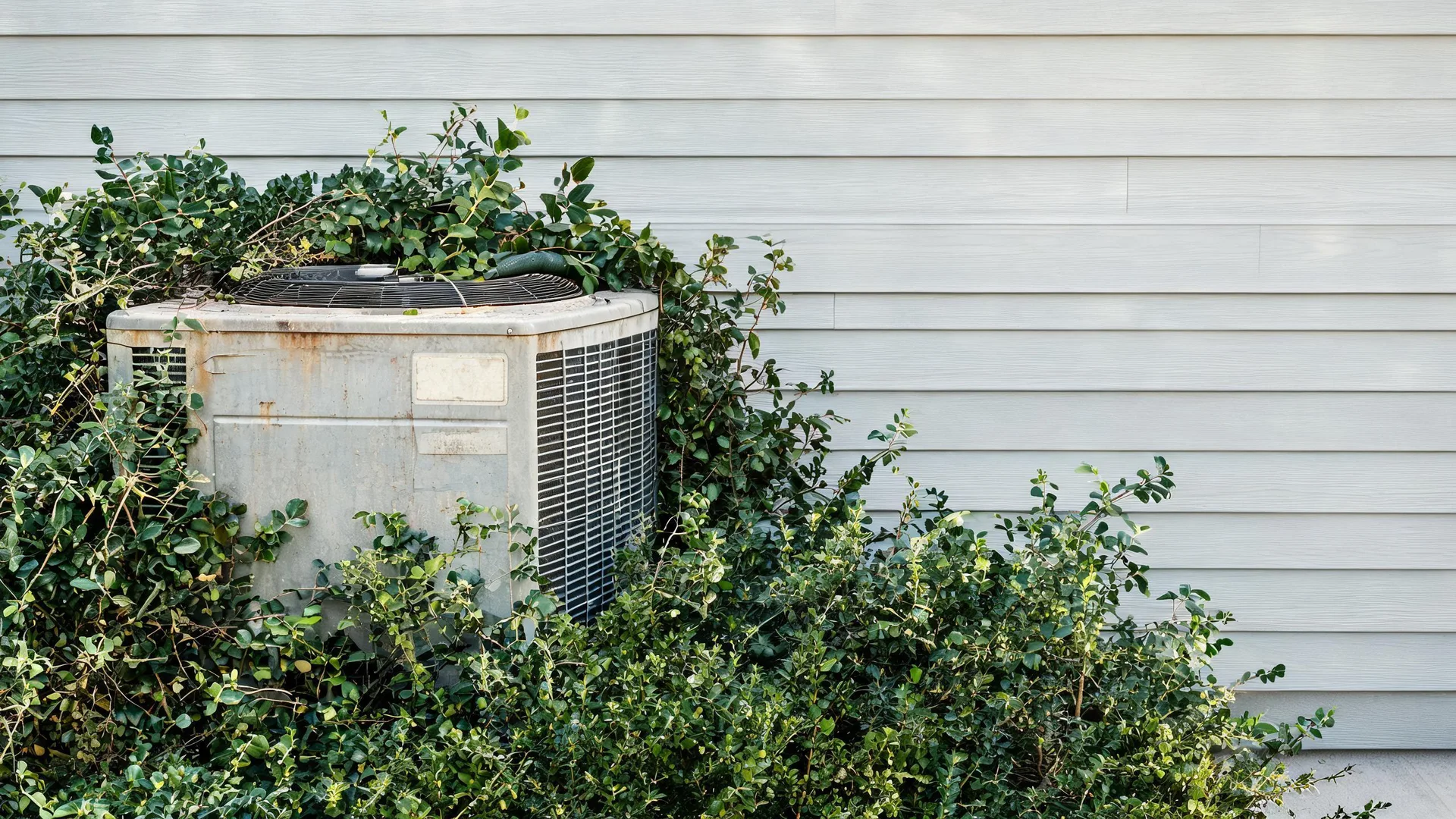
A gray heat pump condenser unit mounted on a concrete pad against the gray lap-siding exterior wall of a house.

Left alone, a small fault asks more of the machine every time it runs

A heat pump that's low on refrigerant doesn't just run less efficiently. It keeps calling for more runtime to make up the difference, and that extra runtime puts more hours on the compressor than it was ever meant to see. A reversing valve that's starting to stick works the same way. It drifts further from sealing right each time it's asked to switch, until one day it doesn't switch at all. Short cycling wears the contactor and the start components with every extra start, not just the system overall. None of this fixes itself by waiting. The part doesn't rest and recover between cycles. It just gets asked to do the same strained job again the next time the thermostat calls.

The reversing valve is usually where it starts

The reversing valve is what lets a heat pump switch between heating and cooling, and it fails in a couple of ways. The coil that controls it can burn out, or the valve itself can get stuck from wear or from debris caught in it. Either way, the system gets stuck in one mode or starts blowing air that's the wrong temperature for what the thermostat is asking for.
Refrigerant problems rarely mean a leak you'll find today

Low refrigerant charge almost always comes from a slow leak somewhere in the line set or coil, and slow leaks don't announce themselves. The system just keeps running longer to hit the same temperature, the coil can start icing over, and the compressor ends up working harder than it should for months before anyone notices. Finding the actual leak point takes a gauge set and some patience, not a guess.

Before anyone comes out, there are a few things worth checking yourself. Look at the thermostat first. Make sure it's set to heat, not cool, and that the set temperature is actually above room temperature. A setting bumped by accident explains more service calls than people expect. Check your breaker panel for anything tripped, since a heat pump pulls a fair amount of current on startup and a loose breaker can trip without any other warning sign. Walk outside and look at the outdoor unit. If it's packed with leaves, caked in ice, or the fan can't spin freely, clearing that away sometimes solves the problem on its own. Last, check the filter. A filter clogged with dust chokes airflow, and a system starved for airflow will ice up or run nonstop trying to keep up. None of this takes tools or experience, just a few minutes before you make the call.

Repair makes sense most of the time, because most failures are one part, not the whole system. A bad run capacitor, a failed reversing valve coil, a low charge from a slow leak. Any of those gets fixed on its own, and the rest of the system keeps going. Replacement starts to make more sense when the compressor itself is the problem. A failed compressor often means the refrigerant that passed through it is carrying contamination now, and a new compressor dropped into an old system doesn't always last in there. Age matters less by itself than how the system got to this point. A unit that's been serviced along the way and is failing for the first time is a different case than one that's been quietly losing capacity for years and just hit the point where it can't keep up. Ask what actually failed and why before asking what it costs to fix. That question tells you whether you're looking at a repair or a pattern.