A nighttime street view of several illuminated two-story red brick homes with front porches, flanked by a large tree.

Heat Pump Repair in Sioux Center, IA

Tell us about the job

Takes about a minute. No obligation.

RepairHeat PumpSioux County, IA
Step 1 of 2

What ZIP code is the job in?

A heat pump that works year-round here

A heat pump in Sioux Center carries the hard winter, then switches over and has to pull moisture out of sticky summer air. The dew point averages 60°F across June, July and August, which is heavier air than most of the country deals with. The outdoor unit sits through this twice a year, heating and cooling, with no real break in between.


What that means for a repair call

Sioux County logged 42 hail events and 67 damaging wind events between 2015 and 2024, on top of 37 winter storms. An outdoor unit built to handle that wears sooner than the manual assumes, and small issues turn into breakdowns faster. A noise or a weak cycle is worth having looked at properly, not patched, since the same hard use that caused it will find any shortcut in the fix.

8 months
October through May, your system heats
3 months
June through August, it cools
11°F
the average winter night it heats against
82°F
the average summer afternoon it cools against
Isometric line illustration of a cutaway single-story house showing interior rooms with furniture and ceiling ductwork, connected to an outdoor condenser unit on the ground outside the left wall.
Your system heats October through May and cools June through August.

NOAA nClimDiv, 1991–2020 normals

A refrigerant leak doesn't fix itself once the system keeps running on a low charge.

The compressor has to work harder to move what refrigerant is left, and that's the part that costs the most to replace.

Half these homes are old enough that their heat pump may be near the end of its life

Half the homes here were built by 1973
67 damaging wind events from 2015 to 2024
42 hail events from 2015 to 2024
The first cold snap in October finds the weak spotHeat pumps in Sioux County switch over to heat in October, right as the load tests every part that's been slipping.

Before paying for a repair, it's worth asking how old the heat pump actually is. If it came with the house and the house dates back a while, you could be fixing a unit that's already near the end of what it owes you. A contractor can check the age off the nameplate and tell you where it stands against its expected life. That changes the math on a repair bill. Sinking money into a compressor or a reversing valve makes less sense on a unit with a year or two left than on one that's got a decade ahead of it.

Have the real cause found, not just the symptom

Call it in and let a contractor trace it back to the part that's actually worn, instead of swapping whatever's easiest to reach. A unit that's been cycling through wind, hail and winter storms for years can have more than one thing going on, and a quick patch on the wrong part just means another call later.

Find a contractor
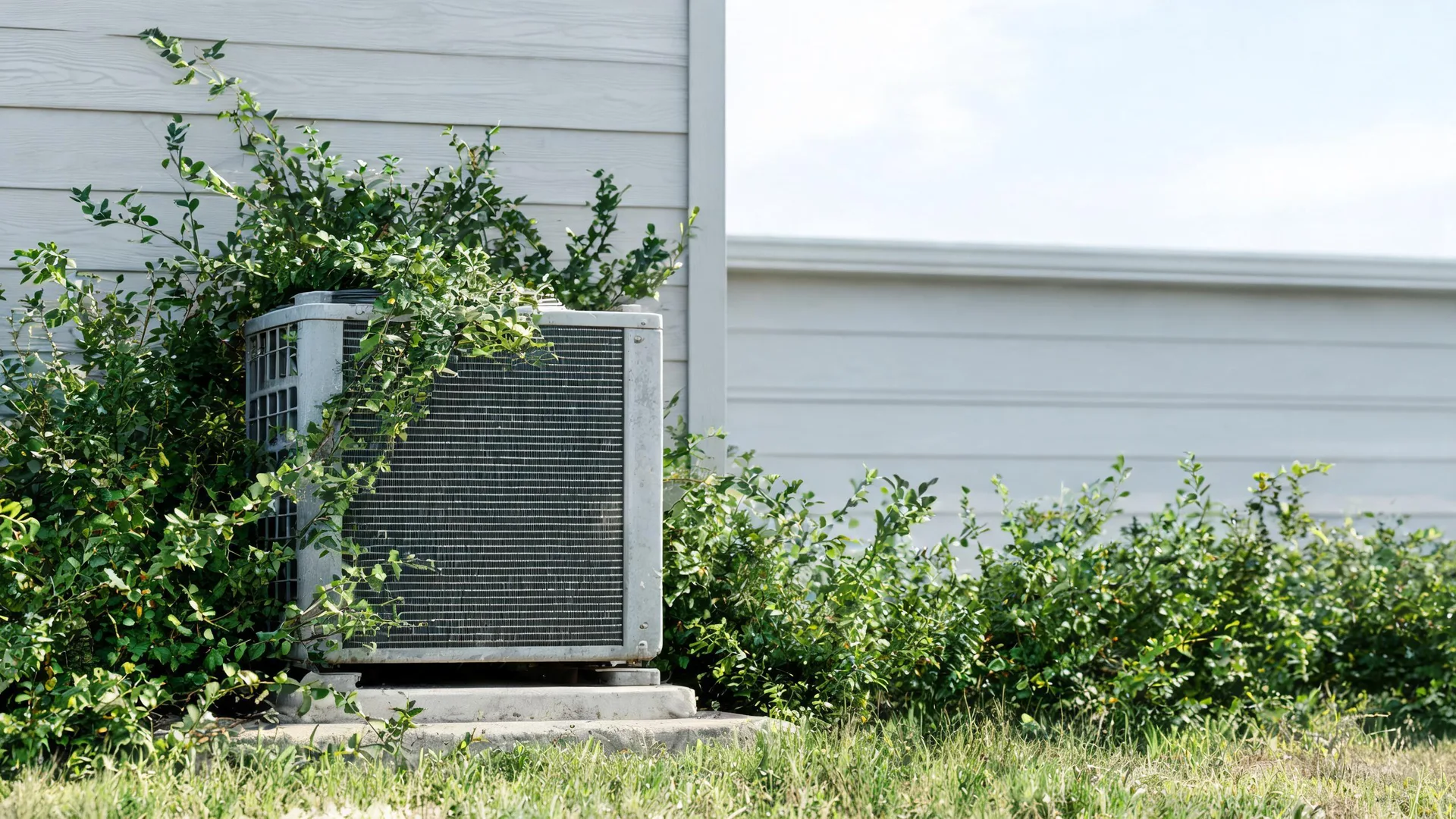
A white mini-split heat pump outdoor unit mounted on a concrete pad beside a gray-sided house, surrounded by gravel and green shrubs.

What you can check before you call

Before anyone comes out, there are a few things worth checking yourself. Look at the thermostat first. Make sure it's set to heat or cool as needed and that the batteries aren't dead, since a blank or frozen display can look like a bigger problem than it is. Walk outside and look at the unit itself. If the coil is covered in leaves, grass clippings or ice, that blocks airflow and can stop the system from working right. A breaker that's tripped will also shut the whole thing down, so check the panel before assuming a part has failed. Inside, pull the air filter and hold it up to a light. If you can't see through it, swap it, because a clogged filter starves the system of airflow and makes it struggle to heat or cool at all. If the outdoor unit is running but the air coming from the vents is cold during heating mode, give it a few minutes. Heat pumps don't blow air as hot as a furnace, and that's normal, not a sign of failure. What you shouldn't touch is the refrigerant line or anything inside the cabinet. That's sealed equipment, and opening it up without the right tools and training can turn a small problem into a much bigger repair.

What a failing heat pump sounds and feels like

A heat pump in trouble usually says so before it quits outright. Short cycling, where the outdoor unit kicks on and off every few minutes instead of running a full cycle, points to a failing capacitor or a thermostat sensing something wrong. Ice building up on the outdoor coil during a heating cycle, past what the defrost cycle clears on its own, means the defrost board or a sensor isn't doing its job. Warm air in cooling mode or cool air in heating mode often traces back to the reversing valve, the part that switches the system between the two. A hissing or bubbling sound near the lines usually means refrigerant is escaping somewhere it shouldn't.

What's worth a call versus what can wait

Not every sign means the same level of urgency. A system that still heats or cools but seems to run longer than it used to is worth watching and worth mentioning on the next service call. A system that's tripping its breaker repeatedly, making a grinding or screeching noise from the outdoor fan motor, or blowing air that never changes temperature needs a contractor out before it goes further. Running a compressor on a low refrigerant charge or with a bad motor bearing turns a repair into a replacement fast, because those parts fail completely once they're pushed past the point of just struggling.

Most heat pump failures trace back to the parts that move. The compressor, the reversing valve, the fan motors, the capacitors that get them started. A capacitor is usually the first to go, since it takes a jolt of power every single cycle and that wears it down over years of normal use. A failing capacitor shows up as a hum with no start, or a fan that spins slow and labors to get going. The reversing valve fails differently, usually by sticking, and a stuck valve either traps the system in one mode or leaves it stuck between the two. Low refrigerant almost always means a leak somewhere in the line set or the coil, not the system using up its charge the way an engine burns oil. A dirty outdoor coil forces the compressor to work against restricted airflow, and heat built up over seasons like that shortens its life even when nothing else is wrong. None of these parts are things a homeowner can diagnose by looking, but what they sound and feel like at the vent or outside the cabinet usually points a contractor straight to the one that's failing.

A repair is worth it when the part that failed is one part, and the rest of the system still has life in it. A new capacitor or a new contactor on a unit that otherwise runs fine is a straightforward call. It gets harder when the compressor is the thing that's failing, since that's the most expensive part to replace and the one that usually signals the whole system is aging out together. Think about what else is original. A unit that's needed two or three different repairs in as many years is telling you something different than a unit on its first service call ever. If the ductwork, the thermostat and the rest of the system are all still in good shape, fixing the one broken part makes sense. If the contractor finds corrosion on the coil, a compressor that's working harder than it should, and a capacitor that just failed, that's not one problem anymore, that's a system reaching the end of what it has.